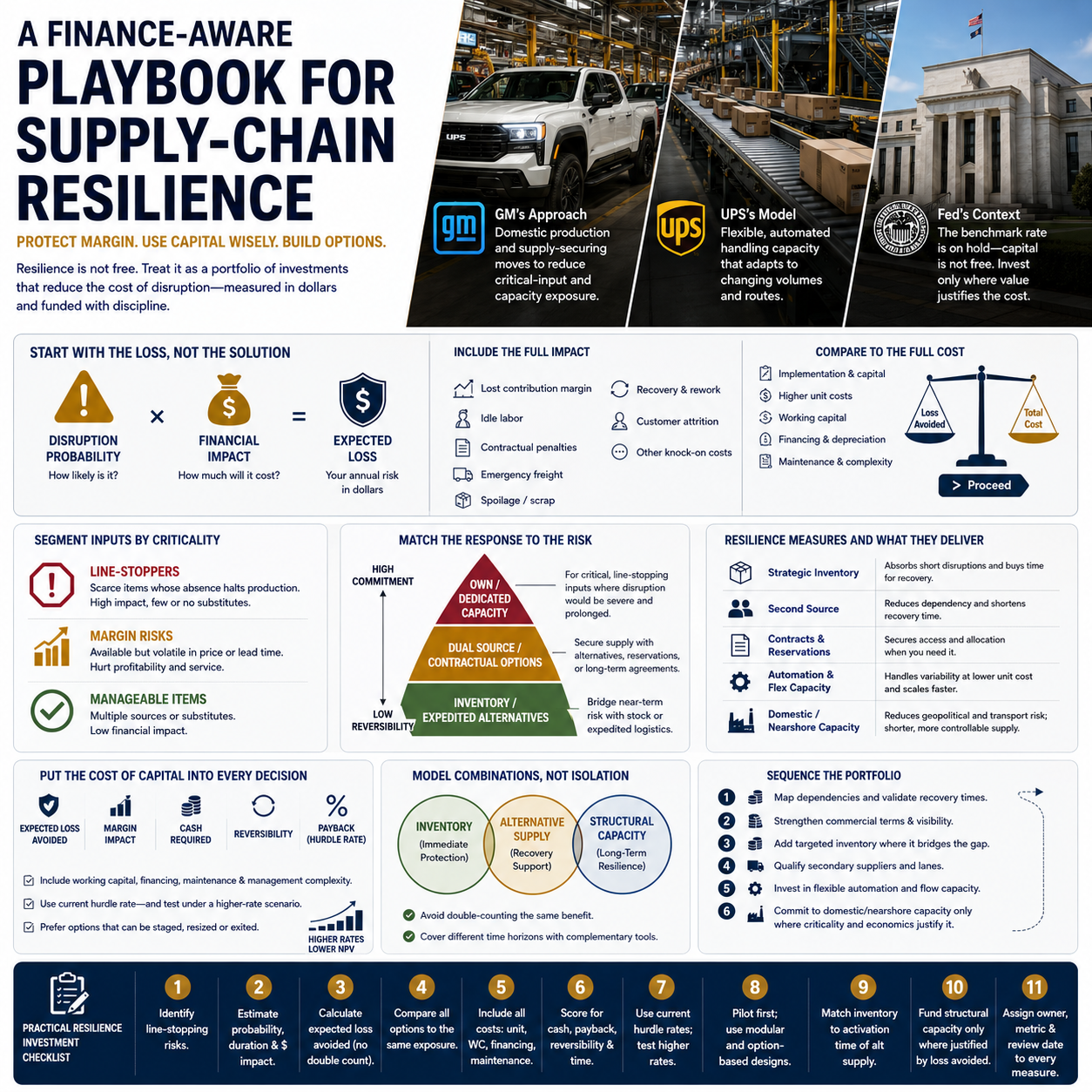
Resilience is easy to endorse and difficult to fund. When commodities, freight and borrowing all remain expensive, operators cannot simply add suppliers, inventory, domestic capacity and automation at once. Each measure absorbs cash or raises operating costs, while its benefit—the disruption that never happens—is uncertain.
The better approach is to treat resilience as a portfolio of investments. General Motors offers the central example: its domestic production and supply-securing moves show how a company can reduce exposure around critical inputs and capacity. UPS illustrates a complementary model built around flexible, automated handling capacity. The Federal Reserve’s decision to hold its benchmark rate steady reinforces the financial constraint: capital cannot be treated as free.
The reported company actions and rate decision below come from the linked articles. The scoring model and operating recommendations are general guidance rather than claims about those companies.
Start with the loss, not the solution
Before approving a resilience project, quantify the disruption it is intended to prevent. For each vulnerable product, input or lane, estimate the annual expected loss:
Expected loss = disruption probability × financial impact.
Impact should include more than emergency freight. Count lost contribution margin, idle labor, contractual penalties, spoilage, recovery costs and customer attrition where those effects can be estimated responsibly. Use ranges rather than false precision, and test a normal case, a severe case and a prolonged disruption.
Then compare expected loss avoided with the full cost of the intervention. That cost includes implementation spending, higher unit prices, working capital, financing, depreciation, maintenance and internal complexity. A second supplier that raises input costs every month may be less attractive than inventory protecting the same exposure for six weeks—or substantially more attractive if replenishment would take a year.
This reframes resilience from “How much redundancy do we want?” to “Which exposures justify paying for protection?”
Use GM’s model selectively, not universally
Supply Chain Dive reports that GM is pursuing resilience through domestic production and moves to secure supply. That direction is most defensible where an input is strategically critical, substitution is difficult and interruption could stop high-margin output. It is not a blanket argument for localizing every component.
Operators can apply the same logic by segmenting inputs into three groups. First are line-stoppers: scarce components or materials whose absence halts production. Second are margin risks: inputs that remain available but experience damaging price or lead-time volatility. Third are manageable items with substitutes, multiple qualified sources or low financial impact.
Domestic or nearshore capacity deserves consideration for the first group when it shortens recovery time, improves visibility or reduces geopolitical and transport exposure. But the business case must recognize potentially higher conversion costs and capital requirements. Secure-supply arrangements—such as long-term contracts, reservations or qualified alternative sources—may capture much of the benefit without owning capacity.
The practical lesson is to match commitment to criticality. Ownership and dedicated capacity are high-commitment responses. Dual sourcing and contractual options sit in the middle. Inventory and expedited alternatives are usually more reversible. Choose the least irreversible measure that materially reduces the exposure.
Build flexibility before adding fixed capacity
UPS provides another resilience pattern. Supply Chain Dive reports that more than two-thirds of its U.S. volume is handled by automated locations. For operators, the relevant principle is not automation for its own sake; it is the ability to process changing volumes and routes with a more adaptable cost structure.
Automation can reduce handling expense, improve throughput consistency and make capacity easier to redeploy. Yet utilization determines the economics. Equipment designed for peak demand can destroy value if it sits underused, requires specialized maintenance or locks the operation into one product format.
Prioritize modular systems, leased equipment, interoperable software and phased rollouts where uncertainty is high. Pilot the bottleneck rather than automating an entire facility. Measure labor hours per unit, throughput, downtime, error rates, maintenance cost and the ability to shift volume during disruption. Release the next investment only when operating evidence supports it.
What most people miss
Resilience measures interact. Extra inventory may bridge the qualification period for a second supplier. Automation may make a nearshore facility viable at lower volume. A contractual capacity reservation may remove the need to build a plant. Evaluating each initiative alone can therefore produce the wrong portfolio.
Model combinations around the same failure scenario and avoid counting the same benefit twice. If both safety stock and a backup supplier address a 30-day outage, their combined loss avoided is not automatically the sum of their individual benefits. The portfolio should cover different time horizons: inventory absorbs the immediate shock, alternative supply supports recovery, and structural capacity protects against persistent disruption.
Put the cost of capital into every decision
The Fed article reports that policymakers held the benchmark rate steady in a vote with three dissents. Whatever the next policy move, operators should evaluate resilience under the financing conditions available now rather than assume rapid relief.
Rank proposals on five dimensions: expected loss avoided, margin impact, cash required, reversibility and payback. Also calculate the working-capital burden. Strategic inventory consumes cash continuously; domestic facilities require upfront capital; supplier qualification consumes engineering and management capacity; automation adds integration and maintenance costs.
Use the company’s approved hurdle rate and run a higher-rate sensitivity. For inventory, compare annual carrying cost with expected disruption loss avoided. For automation, calculate payback from verified labor, error and throughput improvements rather than headline capacity. For contracts, value minimum purchases, deposits and termination terms as real commitments.
When projects score similarly, prefer the one that can be staged, resized or exited. Reversibility has economic value in volatile markets. A six-month supplier option may be worth more than a theoretically cheaper five-year commitment if demand or technology could change.
Sequence the resilience portfolio
A practical sequence begins with inexpensive visibility and commercial safeguards, then advances toward cash-intensive structural changes. Map line-stopping dependencies, validate supplier recovery times and clarify who controls tooling, sub-tier supply and transport. Next, negotiate audit rights, allocation rules, notice periods, indexation formulas and continuity obligations.
Add targeted inventory where disruption arrives faster than an alternative can respond. Qualify secondary suppliers where recovery would exceed the inventory bridge. Use flexible automation where it improves both normal operations and surge response. Reserve domestic or nearshore capacity for exposures whose expected losses and strategic importance justify the commitment.
Review the portfolio quarterly and after material changes in rates, commodity pricing, customer demand or supplier health. Resilience is not a one-time construction project; it is a set of options that must be re-priced as conditions change.
Practical resilience investment checklist
- Identify inputs, lanes and facilities capable of stopping production or materially reducing margin.
- Estimate disruption probability, duration and financial impact using explicit scenario ranges.
- Calculate expected loss avoided without double-counting benefits shared by multiple measures.
- Compare diversification, inventory, contracts, automation and localized capacity against the same exposure.
- Include unit-cost changes, working capital, financing, maintenance and management complexity.
- Score every proposal for cash requirement, payback, reversibility and implementation time.
- Use current hurdle rates and test the business case under higher financing costs.
- Prefer pilots, modular designs and contractual options when demand or technology is uncertain.
- Match inventory coverage to the realistic activation time of alternative supply.
- Fund structural capacity only where criticality and expected loss justify an irreversible commitment.
- Assign an owner, operating metric and review date to every approved resilience measure.